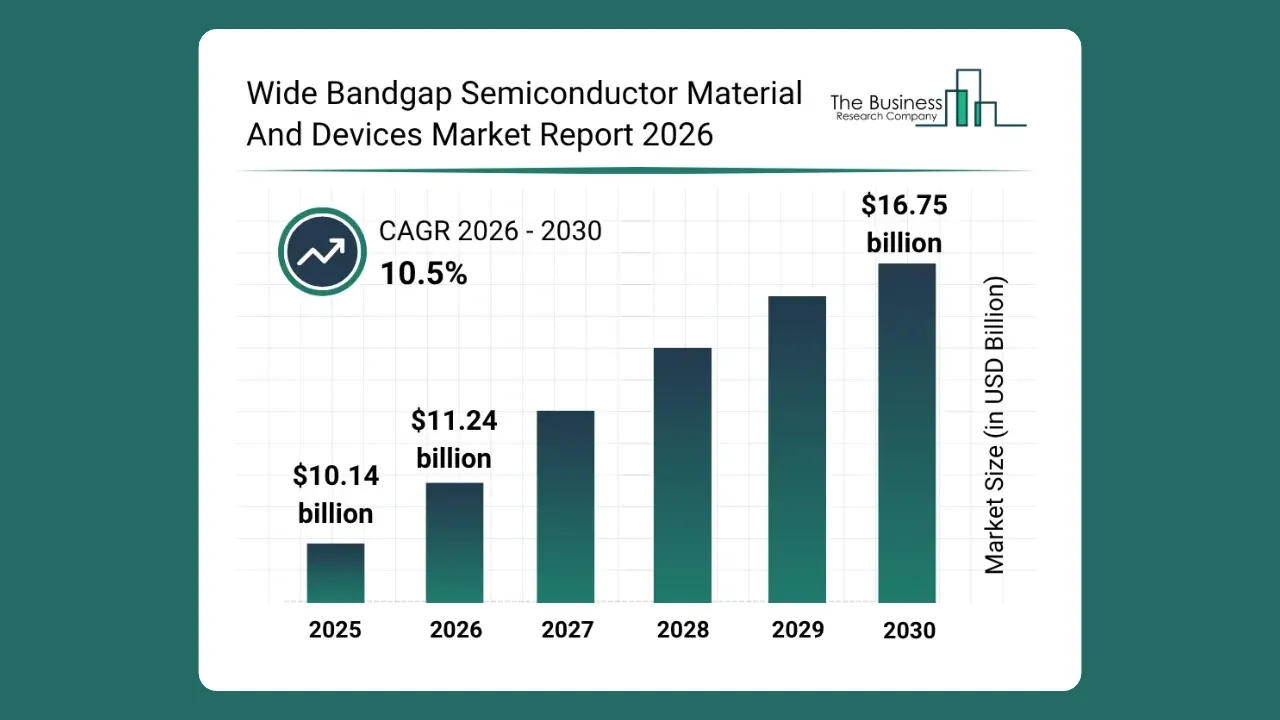
The global push for high-efficiency power electronics is accelerating the transition from traditional silicon to wide bandgap (WBG) semiconductor materials. As enterprise and industrial requirements shift toward higher thermal stability and faster switching, the market is positioning itself for significant scaling. According to recent data from The Business Research Company, the sector is projected to grow from a $10.14 billion valuation in 2025 to an estimated $16.75 billion by 2030. This trajectory reflects a fundamental shift in how power density and voltage management are handled across modern electronic infrastructures.
Scaling Toward a $16.75 Billion Valuation
The wide bandgap semiconductor material and devices market is entering a phase of sustained expansion, driven by the technical limitations of conventional silicon. The market is expected to rise from $10.14 billion in 2025 to $11.24 billion by 2026, representing a compound annual growth rate (CAGR) of 10.9%. Looking further ahead, the industry is forecasted to reach $16.75 billion by 2030, maintaining a CAGR of 10.5%. This growth is being fueled by the increasing necessity for semiconductor devices capable of operating at higher temperatures and higher breakdown voltages. As manufacturers expand gallium nitride (GaN) device fabrication and increase silicon carbide (SiC) deployment, the industry is addressing the rising demand for next-generation power semiconductor devices. This expansion is not merely a volume increase but a technical pivot toward high-frequency applications and high power density requirements that traditional materials struggle to meet in demanding enterprise environments.
Technical Advantages of SiC and GaN Integration
Wide bandgap semiconductors are distinguishing themselves through a larger energy bandgap compared to standard silicon-based materials. This physical attribute allows these components to operate effectively under higher electric fields, elevated temperatures, and greater voltages while delivering improved efficiency. The market is currently seeing accelerated development in advanced gallium nitride and silicon carbide devices, which offer superior thermal stability and faster switching capabilities. These technical advantages are particularly critical in the electric vehicle (EV) sector, where WBG materials are utilized in powertrains and charging systems to enable faster charging times and better thermal management. The demand is further supported by consumer trends; for example, Kelley Blue Book reported that 1.2 million car buyers in the United States opted for electric vehicles in 2023, accounting for 7.6% of the overall US vehicle market. This shift toward electrification, combined with growing investments in manufacturing capacity, is cementing the role of WBG technologies in high-performance power electronics.
Key Takeaways
- The wide bandgap semiconductor market is projected to reach $16.75 billion by 2030, growing at a CAGR of 10.5%.
- Silicon carbide (SiC) and gallium nitride (GaN) are identified as primary drivers for high-frequency and high-power density applications.
- North America held the largest market share in 2025, though the Asia-Pacific region is expected to see the fastest growth.
TechInsyte's Take
In our view, the projected climb to $16.75 billion signals a structural move away from silicon dominance in power-critical applications. The emphasis on gallium nitride and silicon carbide is not just a trend; it is a response to the physical ceiling of traditional semiconductors. As enterprises demand higher power density and better thermal management—particularly in EV infrastructure and high-frequency electronics—WBG materials are becoming a necessity rather than an elective upgrade. We believe the rapid growth in the Asia-Pacific region will be the critical variable for supply chain stability, as manufacturing capacity investments attempt to keep pace with the escalating technical requirements of the next decade.
Questions & Answers
How does the energy bandgap of these materials impact enterprise hardware performance?
Wide bandgap materials allow devices to operate under higher electric fields, elevated temperatures, and greater voltages. This results in superior thermal stability, enhanced breakdown voltage, and faster switching capabilities compared to traditional silicon.
What specific market segments are driving the demand for WBG semiconductors?
The market is being propelled by the increasing adoption of electric vehicles (EVs), which require WBG materials for efficient powertrains and faster charging systems, as well as the growing need for high-frequency and high-power density applications.
What is the projected growth rate for this sector through 2030?
The market is expected to grow from $10.14 billion in 2025 to $11.24 billion in 2026 (a 10.9% CAGR), eventually reaching an estimated $16.75 billion by 2030 at a CAGR of 10.5%.
Which geographic regions are most significant to the WBG market landscape?
While North America held the largest market share in 2025, the Asia-Pacific region is expected to experience the fastest growth during the forecast period.
Source: The Business Research Company