The drive toward decentralized, low-latency intelligence is pushing the edge artificial intelligence (AI) chips market toward a projected valuation exceeding $15 billion by 2030. This specialized segment is carving out a critical niche within the broader $920 billion AI ecosystem, representing a strategic shift from centralized cloud processing to localized, real-time computation. As enterprises increasingly demand immediate decision-making capabilities in industrial and consumer environments, the hardware supporting these functions is transitioning from a peripheral component to a core infrastructure requirement. This growth is underpinned by a projected 17% compound annual growth rate (CAGR) leading up to 2030, signaling a massive reallocation of semiconductor R&D toward edge-optimized architectures.
North American Dominance and US Market Expansion
North America is positioning itself as the primary engine for edge AI chip adoption, with an estimated market valuation of $4.8 billion by 2030. This regional leadership is expected to grow from a $2.2 billion baseline in 2025, maintaining a 16% CAGR. The concentration of top-tier AI semiconductor firms and large-scale technology providers in the region is a primary driver, alongside heavy investments in next-generation semiconductor technology and edge computing infrastructure.
Within this regional landscape, the United States is projected to emerge as the largest individual country market, valued at $4.2 billion in 2030. Starting from $2.0 billion in 2025, the US market is expected to mirror the 16% CAGR seen across North America. The report attributes this trajectory to the rapid commercialization of edge AI technologies and the deep integration of AI processors into autonomous systems and intelligent robotics. Furthermore, the US market is being bolstered by significant R&D investments targeting advanced chip design and the expanding deployment of AI within the healthcare and industrial sectors. This domestic momentum is fueled by ongoing innovation from US-based semiconductor companies aiming to maximize both edge computing performance and energy efficiency for enterprise-grade applications.
ASIC Dominance and Technical Architecture Trends
The technical landscape of the edge AI market is increasingly defined by specialization, with application-specific integrated circuits (ASICs) projected to become the largest chip segment. By 2030, ASICs are expected to account for 42% of the total market, representing approximately $6 billion in value. This dominance is driven by the industry's move toward dedicated AI acceleration and the need for superior energy efficiency during edge AI inference tasks. As autonomous vehicles and smart IoT devices scale, the demand for application-optimized processors that can handle specific workloads without the overhead of general-purpose hardware is intensifying.
Beyond ASICs, the market is seeing significant expansion across several key chip architectures. Between 2025 and 2030, individual chip markets are expected to grow as follows: GPUs are projected to expand by $3 billion, CPUs by $1 billion, and FPGAs by $0.4 billion. Collectively, these chip types—alongside ASICs—are projected to generate over $8.4 billion by 2030. This diversification reflects a multi-pronged approach to solving the challenges of real-time AI, where different workloads require different balances of power, flexibility, and raw throughput. Companies are increasingly focusing on heterogeneous AI chip architectures and advanced neural processing units to meet these varied requirements.
Key Takeaways
- The edge AI chips market is forecasted to exceed $15 billion by 2030, growing at a 17% CAGR.
- ASICs are expected to lead the segment, capturing 42% ($6 billion) of the market by 2030 due to demand for energy-efficient inference.
- North America is set to lead the global market in 2030 with a projected valuation of $4.8 billion.
TechInsyte's Take
In our view, the projected growth of the edge AI chip market signals a fundamental architectural shift in how enterprise intelligence is deployed. The fact that ASICs are expected to command 42% of the market suggests that the era of "one-size-fits-all" general-purpose computing at the edge is ending. For CIOs and CTOs, this means the hardware procurement strategy must move away from generic silicon toward highly specialized, workload-specific accelerators.
The heavy concentration of value in North America, particularly the US, underscores the importance of domestic semiconductor resilience. As companies like NVIDIA and Qualcomm lead the charge, the competitive moat is no longer just about raw transistor counts, but about the integration of hardware-software stacks—exemplified by platforms like Ambarella’s Cooper. We believe the real battleground for market leadership will be won by those who can provide the most seamless "developer experience," reducing the friction between complex AI models and the constrained power envelopes of edge devices. The transition to the edge is not merely a trend; it is a necessary response to the latency and privacy limitations of the cloud.
Questions & Answers
How much of the total Information Technology sector will edge AI chips represent by 2030?
By 2030, edge AI chips are projected to represent approximately 0.1% of the total Information Technology sector, which is forecasted to be worth $13,788 billion.
Which specific chip architectures are expected to drive the most value through 2030?
The market is seeing significant growth across several architectures: ASICs are expected to contribute $6 billion, GPUs $3 billion, CPUs $1 billion, and FPGAs $0.4 billion.
What are the primary drivers behind the projected 16% CAGR in the US market?
The US market growth is driven by the rapid commercialization of edge AI, the integration of AI processors into autonomous systems and robotics, expanded use in healthcare and industrial sectors, and heavy R&D in advanced chip design.
How is the competitive landscape structured in the edge AI chip market?
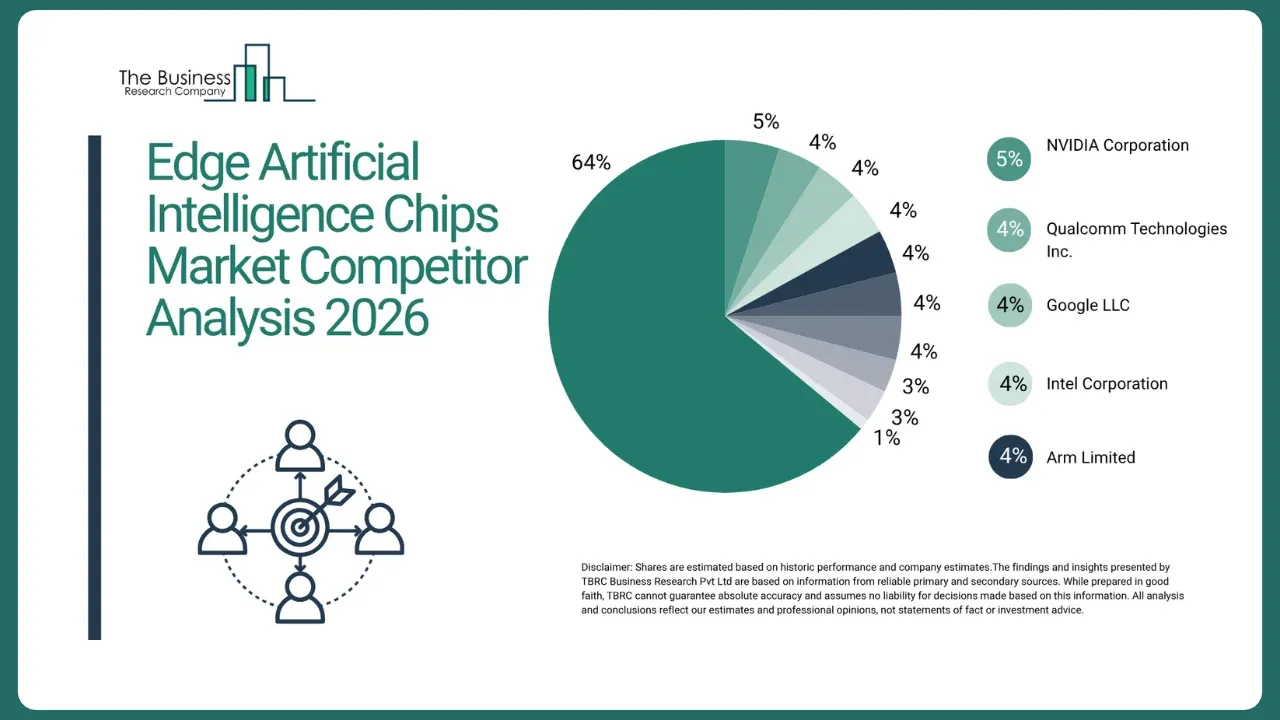
The market exhibits moderate concentration, with the top 10 companies accounting for 36% of total market revenue in 2025. Leading players include NVIDIA Corporation, Qualcomm Technologies Inc., Google LLC, and Intel Corporation.
Source: The Business Research Company