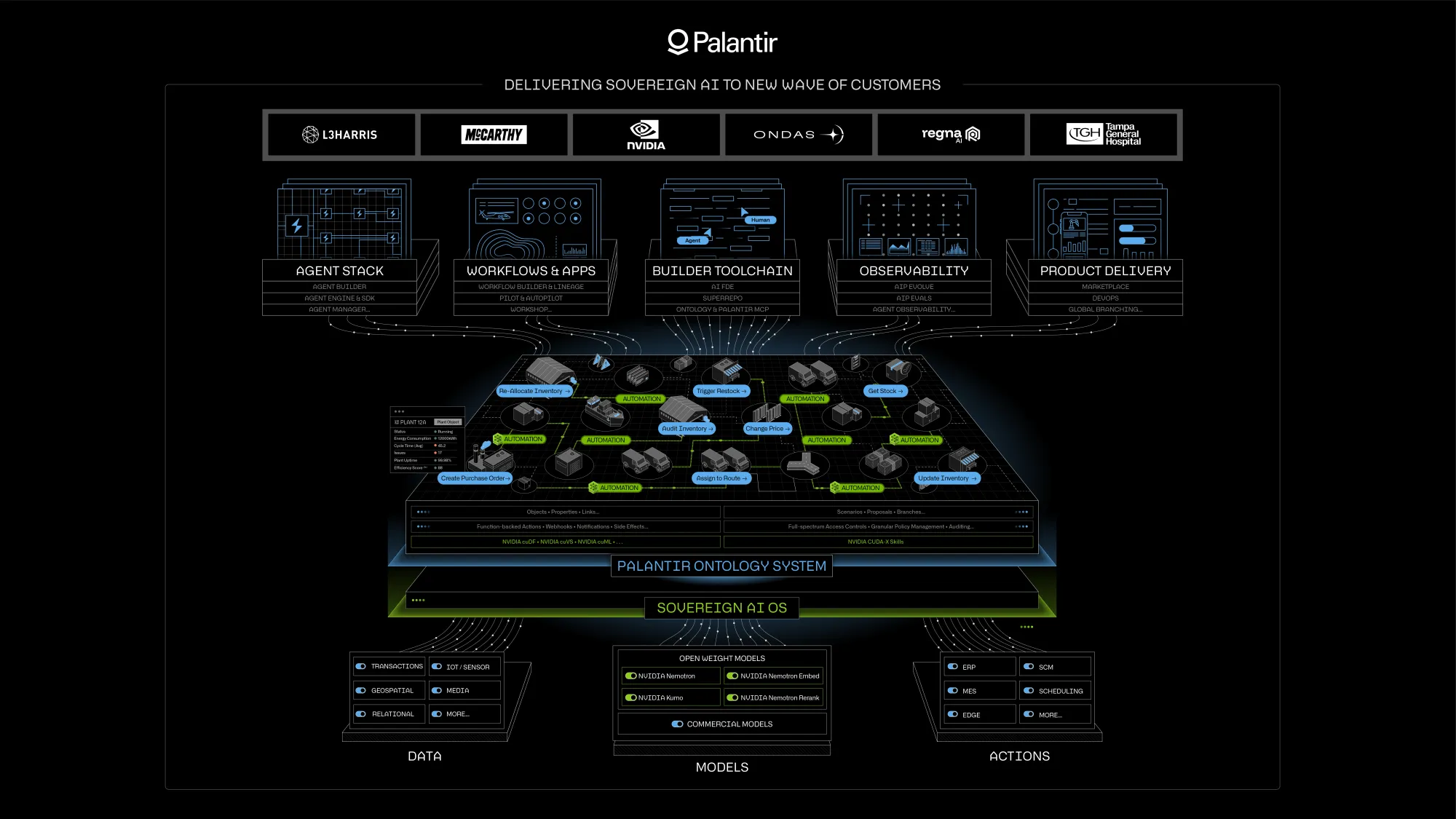
Palantir Technologies is aggressively expanding its footprint in the sovereign AI market by enabling flagship customers to build proprietary intelligence layers on top of their own data and compute infrastructure. By leveraging the Palantir Foundry, Ontology, and Artificial Intelligence Platform (AIP) alongside NVIDIA’s Nemotron open models, a diverse group of enterprises is attempting to bypass general-purpose "frontier" models in favor of specialized, cost-effective alternatives. This strategic shift focuses on data sovereignty, where organizations maintain absolute control over their models and workflows to meet specific security, regulatory, or operational requirements. The move signals a growing enterprise demand for AI that is purpose-built for industry-specific nuances rather than broad, generic capabilities.
L3Harris and McCarthy Building Deploy Specialized Models
Defense and construction leaders are utilizing Palantir’s infrastructure to transition from general AI to highly specialized, sovereign intelligence. L3Harris is integrating and fine-tuning open-source models on its own enterprise data to support national security missions. The company has unified over 30 ERP systems and generated approximately 3.5 million data connections and 5,000 scheduled data feeds through the Palantir Ontology. L3Harris reports that testing sovereign models on internal work allowed them to outperform frontier labs in specific test environments while cutting costs by 95%. The company aims to partner with Palantir to explore building models that inform mission systems pairing during field operations, specifically targeting the enhancement of hardware systems like VAMPIRE.
In the construction sector, McCarthy Building Companies is deploying an AI operating system to integrate 160 years of institutional knowledge into field workflows. By fine-tuning a Nemotron 3 Nano 4B model within Foundry and training it on over 100,000 production Requests for Information (RFIs), McCarthy aims to predict cost and schedule impacts. The company has also developed an AI-assisted workflow for subcontractor drafting, utilizing post-trained Nemotron on NVIDIA compute. McCarthy claims this specific implementation has delivered better performance than frontier models at a lower cost, resulting in an estimated 30,000 hours saved annually.
NVIDIA and Tampa General Optimize Supply Chains and Healthcare
NVIDIA is utilizing the Palantir AIP platform and NVIDIA Agent Knowledge Foundation to manage its own complex global supply chain. By employing post-trained Nemotron models, NVIDIA is building an operating system designed to shorten the "wafer to deployment" timeline. This system is intended to optimize supply flow across its network, allowing teams to identify potential constraints earlier and evaluate alternatives more rapidly. NVIDIA's supply chain teams are positioning this as a method to maintain control over proprietary data and customized workflows while accelerating the speed at which customers reach "the first token."
In the healthcare sector, Tampa General Hospital (TGH) is implementing sovereign AI to address the stringent privacy requirements of patient data. TGH is working to keep sensitive data and model processing local, utilizing fine-tuned Nemotron models to classify Large Language Model (LLM) traffic against the hospital's specific risk and privacy standards. This approach aims to provide more granular compliance controls than general-purpose tools. According to the hospital, this specialized implementation has improved model performance by 7% and reduced latency by 22x, supporting critical functions such as reducing patient hold times and flagging early signs of sepsis.
Key Takeaways
- L3Harris reports that its internal testing of sovereign models outperformed frontier labs while reducing costs by 95%.
- McCarthy Building Companies utilizes fine-tuned Nemotron models to save an estimated 30,000 hours annually in subcontractor drafting.
- Tampa General Hospital achieved a 22x reduction in latency and a 7% improvement in model performance through localized, fine-tuned Nemotron models.
TechInsyte's Take
In our view, the trend highlighted by Palantir and NVIDIA is a decisive move away from the "one-size-fits-all" AI model toward a fragmented but highly efficient landscape of sovereign, industry-specific intelligence. The claims made by L3Harris and McCarthy—specifically regarding massive cost reductions and outperforming frontier models—suggest that for specialized enterprise workflows, the massive scale of general-purpose LLMs may actually be a liability rather than an asset. By focusing on the "Ontology" layer, Palantir is effectively selling the ability to turn proprietary, messy enterprise data into a competitive moat. This signals that the next phase of enterprise AI competition will not be won by who has the largest model, but by who can most effectively wrap specialized, low-latency models around their unique, protected data silos.
Questions & Answers
How does sovereign AI differ from using general-purpose frontier models in an enterprise context?
Sovereign AI allows organizations to build, train, and deploy models using their own proprietary data and compute infrastructure. Unlike general-purpose models, this approach ensures the enterprise retains full ownership of the models and workflows, providing higher levels of security, zero-retention capabilities, and industry-specific tuning that frontier labs may not offer.
What specific operational efficiencies have McCarthy Building Companies reported?
McCarthy Building Companies has utilized fine-tuned Nemotron models to automate subcontractor drafting, which they claim saves 30,000 hours annually. Additionally, they use AI to analyze over 100,000 production RFIs to predict potential cost and schedule impacts before they reach a job site.
How is Tampa General Hospital addressing the privacy risks associated with LLM deployment?
Tampa General Hospital is implementing sovereign AI to keep sensitive patient data and model processing local. They are using fine-tuned Nemotron models to classify LLM traffic against their own specific risk and privacy standards, providing more granular control than general-purpose AI tools.
What role does NVIDIA play in the Palantir ecosystem regarding supply chain management?
NVIDIA uses Palantir's AIP platform and the NVIDIA Agent Knowledge Foundation to build an operating system that optimizes its own supply chain. This system uses post-trained Nemotron models to identify supply constraints earlier and accelerate the path from wafer production to deployment.
Source: Palantir