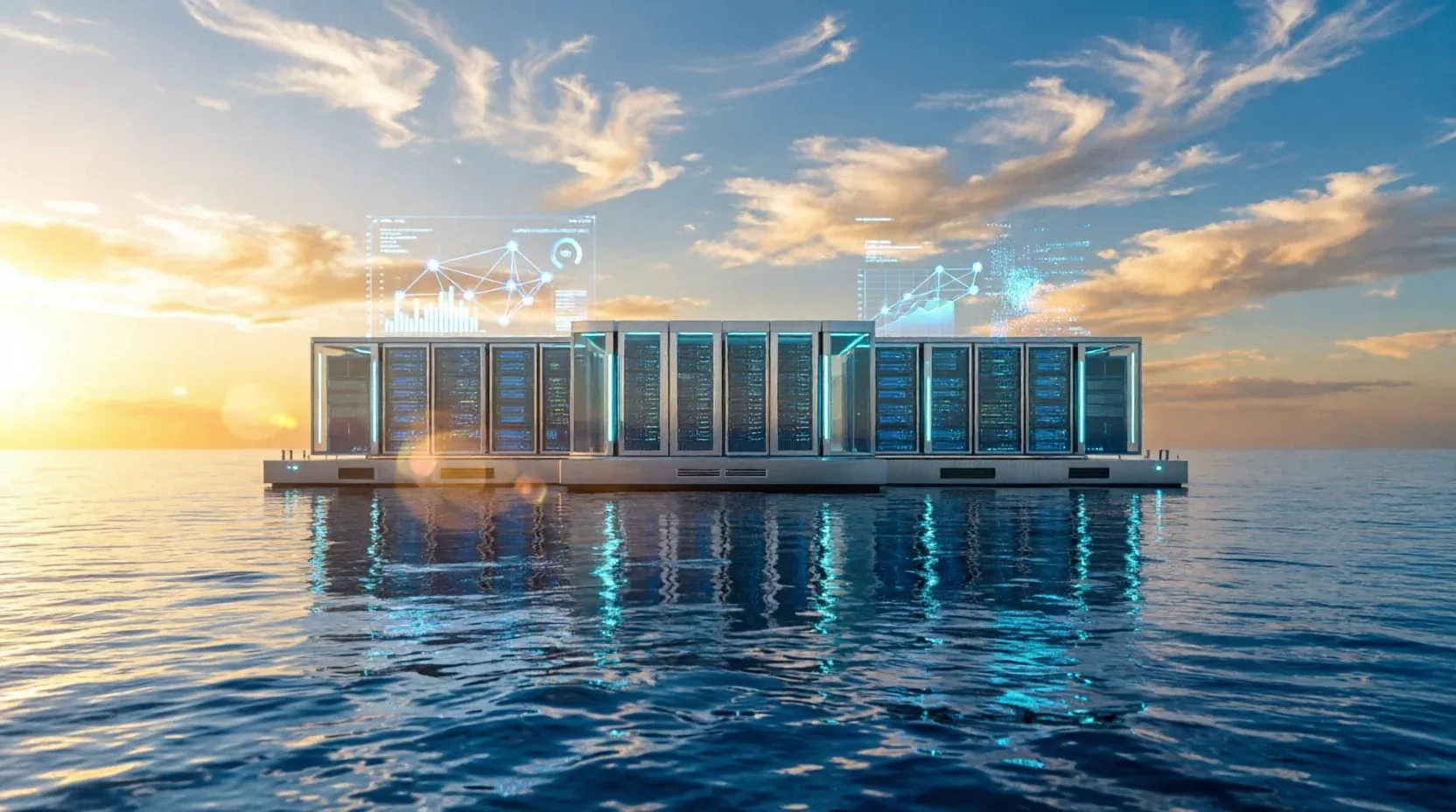
Mousterian Corporation (M3) and Samsung Heavy Industries (SHI) have signed an engineering contract to develop the first moored floating data center (FDC) deployment in the United States. This agreement transitions their April 2026 strategic cooperation from a framework into active execution. The project focuses on purpose-built units designed to deliver 50 MW of critical IT capacity per facility. Targeted for deployment in Texas and other major U.S. markets, this initiative aims to address the growing demand for high-density AI compute by utilizing maritime engineering to bypass the land-based constraints currently impacting traditional data center infrastructure development.
M3 and SHI Engineering Contract for U.S. Deployment
The newly signed engineering contract mandates that M3 and SHI jointly perform basic design, detailed engineering, and production design for moored FDC units. Each facility is engineered to provide 50 MW of critical IT capacity. This technical program establishes the necessary baseline for a future definitive Engineering, Procurement, and Construction (EPC) contract, which the companies intend to execute during or before the completion of current engineering works. The American Bureau of Shipping (ABS) is expected to act as the classification society for this project.
This collaboration leverages M3’s expertise in site origination, power partnerships, and data center design alongside SHI’s established maritime engineering and large-scale fabrication capabilities. By moving from a memorandum of understanding to a formal engineering agreement, the partnership is now focused on the technical realization of these floating assets. The project is positioned to deploy these units in Texas and other strategic U.S. locations to meet the urgent requirements of hyperscale and AI compute workloads.
Sustainable 50 MW Floating Data Center Design
The FDC design prioritizes high-density, liquid-cooled AI compute while maintaining a low power usage effectiveness (PUE). To ensure environmental sensitivity, the facilities utilize bulk non-evaporative cooling. This system consumes no potable water and ensures zero process discharge is returned to the surrounding waterways. Furthermore, by eliminating the air-cooled chillers and fans standard in conventional data centers, the design achieves a minimal noise profile, reducing noise pollution for nearby communities.
A primary strategic advantage of this model is the ability to site facilities adjacent to existing power generation assets. This approach allows operators to access stranded baseload generation and maritime infrastructure that is often unreachable for land-based developments. Because the units are fabricated in a shipyard to maritime standards, fabrication can occur in parallel with site preparation. This parallel workflow is intended to compress delivery timelines for AI-class facilities, offering a schedule and scale that traditional, land-constrained construction methods cannot currently match.
Key Takeaways
- M3 and SHI are engineering moored floating data centers that deliver 50 MW of critical IT capacity per unit.
- The design utilizes non-evaporative cooling to eliminate potable water consumption and process discharge.
- Shipyard-based fabrication allows construction to run in parallel with site work to accelerate deployment timelines.
TechInsyte's Take
In our view, this partnership represents a significant pivot toward maritime-industrial solutions to solve the terrestrial data center power crisis. By utilizing shipyard fabrication, M3 and SHI are treating data centers as modular maritime assets rather than traditional real estate projects. This shift is critical for CIOs facing the "land-and-power" bottleneck. The ability to tap into stranded baseload power via water-adjacent sites suggests that the next frontier of AI infrastructure may not be on land, but on the water. This model provides a blueprint for scaling high-density compute while simultaneously addressing the ESG pressures of water scarcity and noise pollution.
Questions & Answers
How does the floating data center model address power availability constraints?
The FDC model allows for siting facilities directly alongside existing stranded baseload generation and maritime infrastructure. This enables access to power capacity that is often unavailable to conventional land-based data center developments.
What are the primary environmental advantages of the M3 and SHI design?
The design uses bulk non-evaporative cooling, which consumes no potable water and results in zero process discharge into waterways. Additionally, the removal of air-cooled chillers and fans significantly reduces the facility's noise profile.
How does shipyard fabrication impact the deployment timeline for these facilities?
Because the units are fabricated in a shipyard to maritime standards, fabrication can occur in parallel with site preparation. This parallel execution is designed to compress delivery timelines compared to traditional construction methods.
What is the planned capacity and primary target market for these units?
Each moored floating data center is designed to deliver 50 MW of critical IT capacity. The initial priority is deployment in Texas and other key U.S. markets to support hyperscale and AI compute.
Source: PRNEWSWIRE