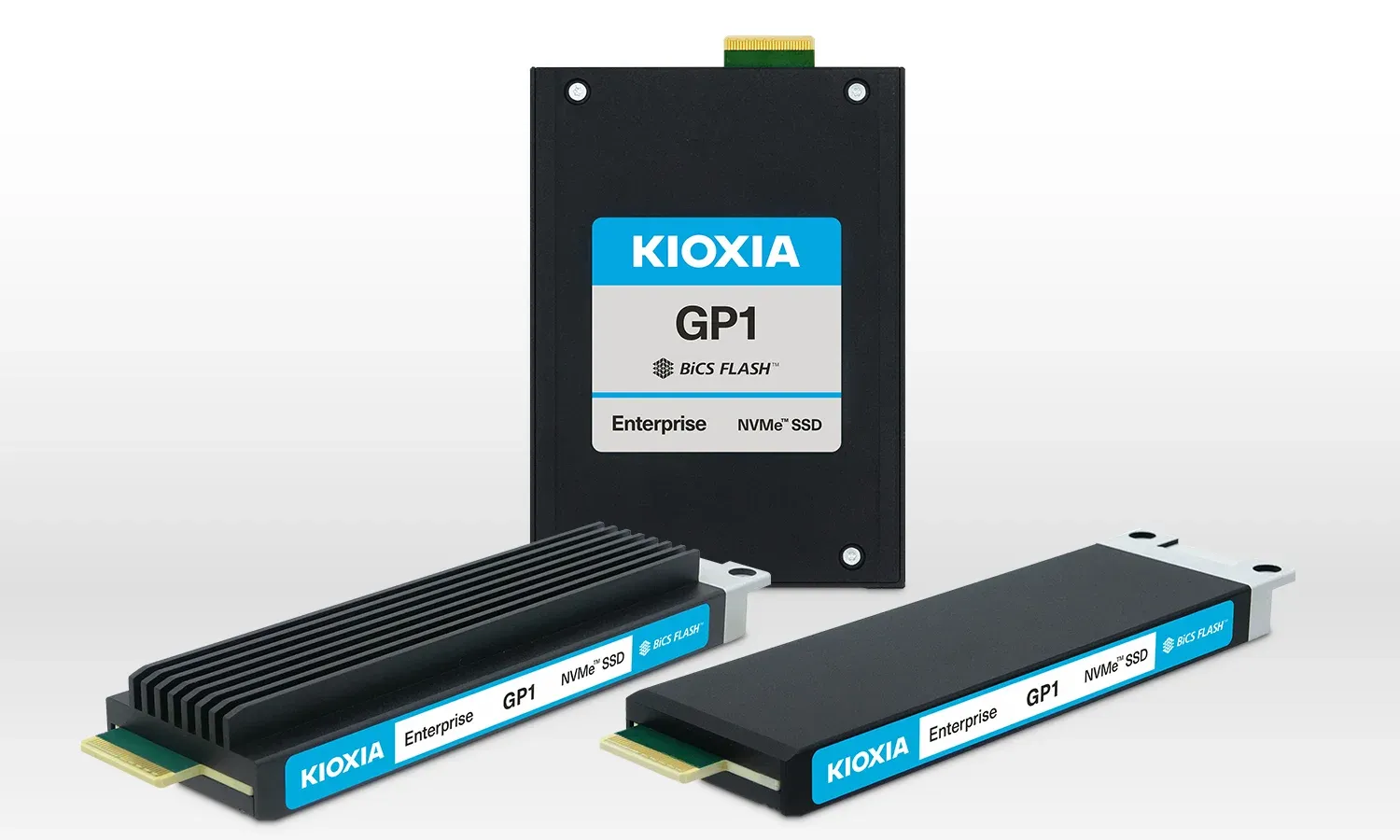
Kioxia Corporation has announced the KIOXIA GP1 Series, a new line of PCIe 6.0 NVMe SSDs engineered specifically for GPU direct access. Utilizing KIOXIA XL-FLASH generation 2 memory, these drives aim to address the escalating performance and memory requirements inherent in modern AI infrastructure. By providing up to 10 million random read IOPS, the series positions itself as a critical component for high-performance computing environments. This development signals a strategic shift toward flash-based memory extensions designed to optimize data access for large-scale artificial intelligence workloads and intensive GPU-driven processing tasks.
KIOXIA GP1 Series Technical Specifications
The KIOXIA GP1 Series represents the first entry in the company's Super High IOPS SSD lineup. Built on the PCIe 6.0 and NVMe 2.2 specifications, these drives leverage KIOXIA XL-FLASH generation 2 technology to achieve up to 10 million random read IOPS at a 512-byte block size. This architecture enables finer-grained data access and lower power consumption per I/O compared to standard TLC-based SSDs. To support diverse hardware configurations, Kioxia is offering the series in E3.S and E1.S (9.5 mm and 15 mm) form factors. Notably, the E3.S and E1.S 9.5 mm versions include cold-plate liquid cooling capabilities, though all form factors remain compatible with traditional air-cooled environments. The drives are rated for up to 50 Drive Writes Per Day (DWPD) endurance. Evaluation samples are scheduled to reach select customers by the end of 2026.
Optimizing AI Storage Architectures
The GP1 Series is specifically designed to integrate into emerging AI storage architectures that function as a fast, flash-based media tier to extend High Bandwidth Memory (HBM). This architectural approach allows AI systems to access significantly larger datasets at a lower cost than increasing HBM4 capacity. By serving as a high-speed extension, the GP1 Series helps improve overall GPU utilization. Kioxia has designed this technology with long-term scalability in mind; while current models target 10 million random read IOPS, the underlying architecture is intended to scale toward future generations capable of reaching 100 million IOPS. This capability is vital for data centers managing the massive throughput required by large language models and complex neural networks. The series will be showcased at the FMS: the Future of Memory and Storage event in Santa Clara, California, from August 4 to 6.
Key Takeaways
- The KIOXIA GP1 Series utilizes PCIe 6.0 and NVMe 2.2 specifications to deliver up to 10 million random read IOPS.
- The series uses KIOXIA XL-FLASH generation 2 memory to provide finer-grained 512-byte data access and lower power consumption per I/O.
- Evaluation samples for the GP1 Series are expected to be available to select customers by the end of 2026.
TechInsyte's Take
In our view, Kioxia’s move to target the gap between HBM and traditional storage is a direct response to the "memory wall" facing AI scaling. By positioning the GP1 Series as a cost-effective extension of HBM, Kioxia is addressing a critical bottleneck for CTOs: the massive expense of scaling HBM4. The focus on PCIe 6.0 and 512-byte granularity suggests a sophisticated understanding of how GPUs consume data. This signals that the industry is moving toward highly specialized, tiered memory hierarchies where ultra-low latency flash becomes an essential component of the primary compute fabric rather than just a secondary storage layer.
Questions & Answers
How does the GP1 Series impact the cost-efficiency of AI hardware scaling?
The GP1 Series allows AI systems to access larger datasets by acting as a fast flash-based tier that extends High Bandwidth Memory (HBM). This provides a significantly lower-cost alternative to increasing HBM4 capacity while simultaneously improving GPU utilization.
What physical deployment options are available for these SSDs?
The drives are available in E3.S and E1.S (9.5 mm and 15 mm) form factors. For high-density thermal management, the E3.S and E1.S 9.5 mm models support cold-plate liquid cooling, though all versions support standard air-cooled environments.
What is the projected performance roadmap for this technology?
The current GP1 Series architecture is designed to deliver up to 10 million random read IOPS. However, Kioxia has designed the architecture to scale for future generations, with a target of reaching up to 100 million IOPS.
When can enterprise customers begin testing this hardware?
Kioxia has stated that evaluation samples will be available to select customers by the end of 2026 for functional checking purposes.
Source: BUSINESSWIRE