
The gap between enterprise AI experimentation and measurable business impact is widening, as most organizations struggle to convert pilot programs into significant value. According to a Gartner survey of 2,002 CIOs and technology executives, only 13% of respondents report that their enterprises have realized significant or transformational value from AI to date. While the volume of AI use cases has accelerated over the past two years, the likelihood of any single use case succeeding remains at approximately one-in-five. This discrepancy suggests that many organizations are prioritizing the rapid deployment of generative AI, traditional AI, and AI agents without establishing the rigorous economic and operational frameworks required to ensure these technologies deliver a return on investment.
The Vanguard Strategy and the Necessity of Stopping Rules
Gartner identifies a specific cohort of high-performing leaders termed "vanguards," who deliver superior business outcomes and maintain high levels of perceived AI value among their CEOs. The data indicates that vanguards distinguish themselves by implementing strict "stopping rules" at two critical stages of the technology lifecycle: the pilot phase and the production phase. Organizations that establish guidelines for determining when an AI pilot should not proceed to production are 2.3 times more likely to be classified as vanguards. Furthermore, those with protocols for abandoning low-value AI initiatives already in the production stage are 2.6 times more likely to achieve vanguard status.
Despite the clear strategic advantage of these disciplined approaches, a significant execution gap persists across the industry. Only 31% of CIOs reported having guidelines to prevent unsuccessful pilots from moving to production, and a mere 17% have established criteria for decommissioning low-value initiatives already in production. Alicia Mullery, VP Analyst at Gartner, notes that "volume is not value," suggesting that organizations lacking the discipline to define use-case value upfront or establish exit criteria face a significant risk of resource depletion.
Managing Probabilistic Costs and Workforce Redesign
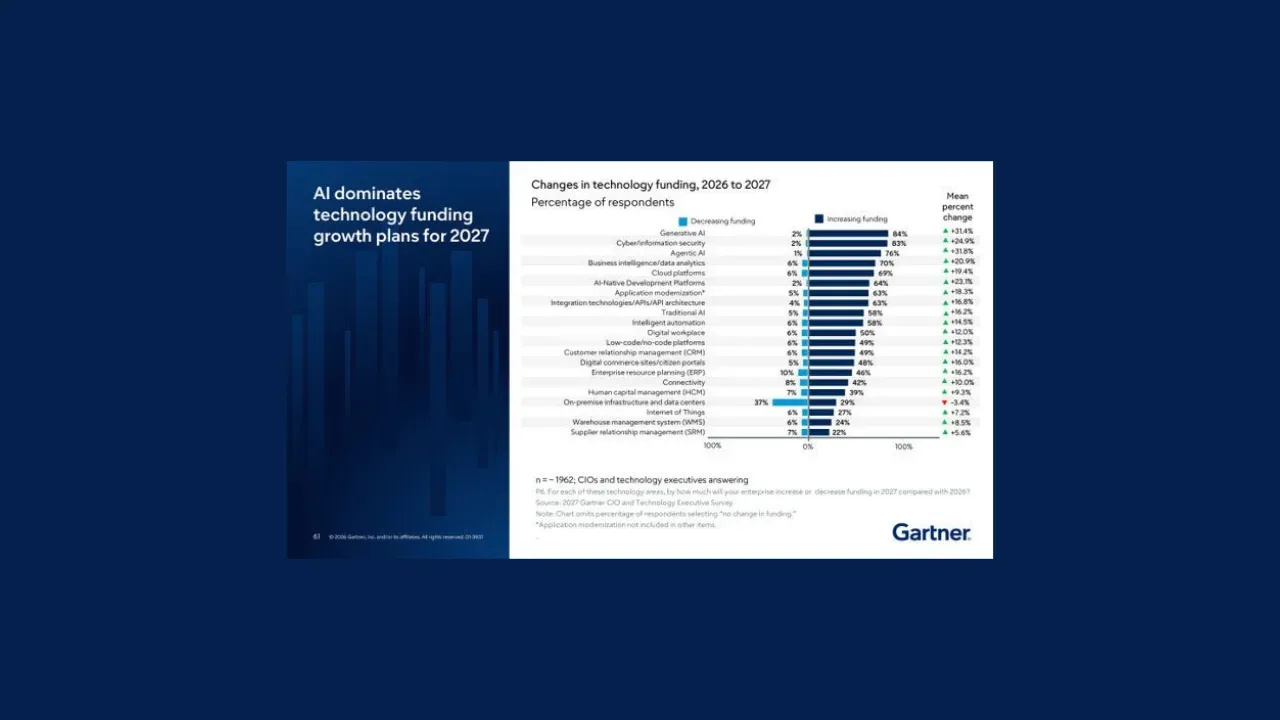
As enterprises shift funding toward GenAI and agentic AI, CIOs are facing a fundamental shift in technology economics. While 58% of CIOs report increased pressure to deliver cost improvements through AI, 51% expect AI to actually increase the total cost of ownership (TCO) for technology solutions. Gartner highlights that traditional funding and governance models, designed for predictable cloud and SaaS investments, are ill-suited for AI. Unlike legacy systems, AI costs are described as "probabilistic" and are often determined at run time, necessitating new approaches to cost accountability and governance.
Simultaneously, the integration of AI is forcing a redesign of the IT workforce. Organizations that have explicit plans to redesign roles for a human-agent workforce are 2.4 times more likely to be vanguards, yet only 4% of CIOs currently report having such plans in place. This workforce shift is not necessarily a headcount reduction exercise; 40% of respondents expect to increase IT headcount in 2027, specifically within cybersecurity and data and analytics. Instead, the role of the IT professional is expected to expand, with the boundaries between specialized tasks—such as design and testing—becoming increasingly blurred as AI assumes more specialized functions.
Key Takeaways
- Only 13% of CIOs report that their enterprises have achieved significant or transformational value from AI investments.
- Organizations with established stopping rules for AI pilots and production are over 2.3 times more likely to be high-performing "vanguards."
- 51% of CIOs expect AI implementation to increase the total cost of ownership for their technology solutions.
TechInsyte's Take
In our view, the Gartner data signals a looming "AI reckoning" for enterprises that have treated generative AI as a standard software rollout rather than a fundamental shift in economic modeling. The fact that only 13% of CIOs are seeing transformational value suggests that the current wave of AI adoption is characterized more by momentum than by strategic precision. The most critical insight for C-suite leaders is the distinction between predictable SaaS costs and the probabilistic, run-time costs of agentic AI. Organizations that continue to apply legacy governance models to these new technologies will likely face significant budget volatility. To move from experimentation to value, CIOs must pivot from being mere technology approvers to becoming economic stewards who are willing to aggressively decommission low-performing AI assets.
Questions & Answers
How can CIOs prevent AI investments from inflating the total cost of ownership?
CIOs must move away from traditional, predictable funding models used for SaaS and cloud. Because AI costs are probabilistic and determined at run time, leaders need to implement new governance frameworks that focus on real-time cost accountability and lifecycle economic stewardship.
What defines a "vanguard" organization in the context of AI adoption?
Vanguards are CIOs who deliver superior business outcomes while maintaining high levels of AI value as perceived by their CEOs. They achieve this by implementing strict "stopping rules" to prevent low-value pilots from reaching production and by proactively abandoning underperforming AI initiatives already in use.
Will the adoption of AI lead to a reduction in total IT headcount?
Not necessarily. While AI may compress certain roles, the data suggests a dual shift: as AI lowers the effort required for specific tasks, the overall demand for technology work increases. 40% of CIOs expect to increase IT headcount in 2027, particularly in data, analytics, and cybersecurity.
Why is workforce redesign critical for AI success?
Organizations with plans to redesign roles for a human-agent workforce are 2.4 times more likely to be vanguards. This redesign acknowledges that as AI handles specialized tasks, the boundaries between traditional roles—such as design and testing—will blur, requiring employees to manage an expanded span of responsibility.
Source: Gartner