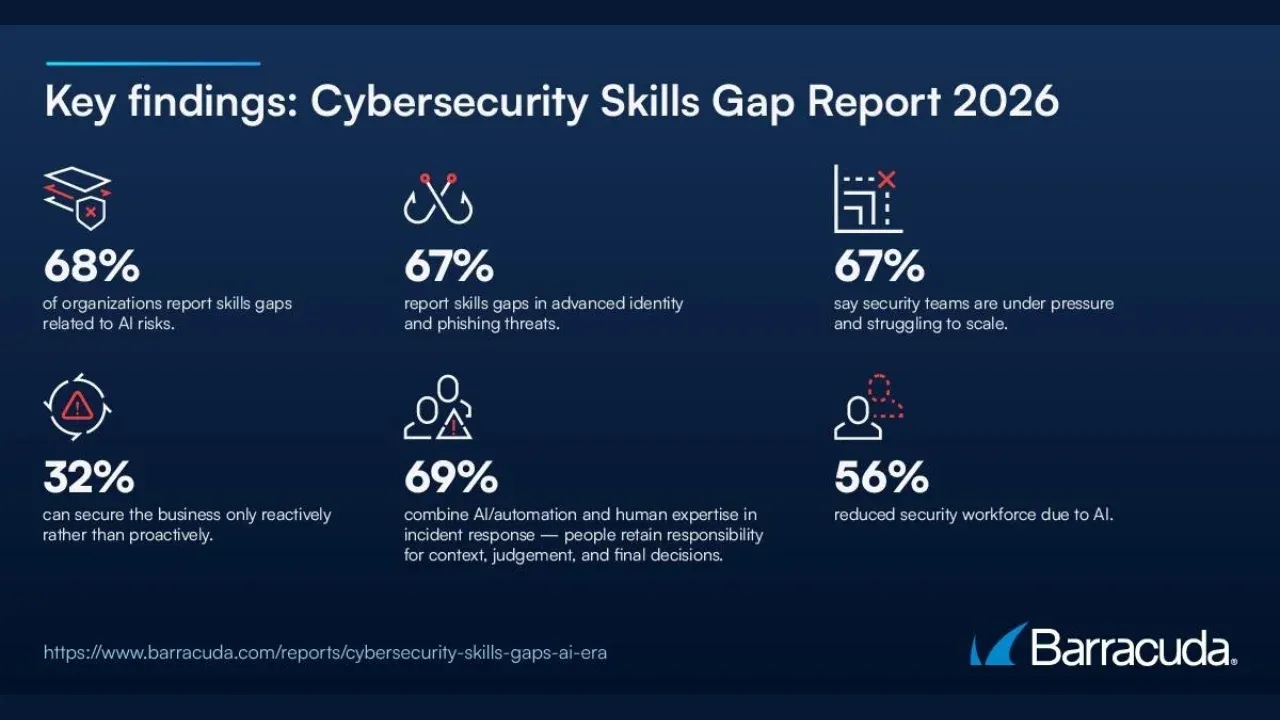
The rapid integration of artificial intelligence into the threat landscape is forcing a fundamental restructuring of cybersecurity departments, often at the expense of existing personnel. A new study from Barracuda Research indicates that 56% of organizations have already implemented workforce reductions linked to AI, with these cuts distributed evenly between entry-level and senior-level roles. This shift occurs as 94% of surveyed organizations report experiencing cybersecurity skills gaps, highlighting a widening chasm between evolving digital threats and the human capacity to manage them. As AI accelerates the pace of attacks, security teams are struggling to scale, with 67% reporting difficulty meeting expanding business needs. This creates a precarious environment where 32% of organizations admit they can only protect their business reactively.
AI-Driven Workforce Reductions and Skills Deficits
The Barracuda Research report, based on an international survey of 2,000 IT and security decision-makers, identifies a direct correlation between AI adoption and changing staffing models. While 79% of organizations report that AI is currently affecting security roles or headcount, the impact is not purely additive. The 56% of companies reporting headcount reductions suggest that organizations are leveraging AI to automate routine tasks, leading to a contraction in staff across all seniority levels. This trend is compounded by a massive deficit in specialized knowledge; 68% of respondents specifically cite gaps related to AI-driven risks, while 67% struggle with advanced identity and phishing threats, such as OAuth abuse and multifactor authentication bypass.
The pressure on remaining staff is intensifying as business expectations outpace current capabilities. According to the findings, 40% of organizations report that business requirements exceed their existing security skills and tooling, and 35% state that expectations have surpassed their staffing capacity. This mismatch is driving a shift in how security teams operate, with 67% of respondents stating they are struggling to scale to meet evolving business demands. Consequently, the ability to maintain a proactive security posture is eroding, leaving nearly one-third of organizations in a reactive defensive loop.
Shifting Competencies in Identity and Incident Response
As AI assumes responsibility for routine analysis and initial response activities, the technical requirements for human security professionals are undergoing a significant transformation. The research suggests that human roles are migrating toward high-level functions such as threat investigation, incident leadership, automation governance, and business risk management. This transition requires a new blend of expertise; 56% of organizations report a specific need for enhanced skills in incident response, decision-making under pressure, and risk assessment. Furthermore, 61% of respondents identified a growing need for strategic security leadership, specifically regarding AI governance and the ability to translate technical risks into business-level impacts.
Despite the automation of entry-level tasks, the human element remains central to the decision-making architecture. The study found that 69% of organizations utilize a shared decision-making model during incident response, where AI provides the investigative data and analysis, but humans retain final responsibility for context and judgment. However, a structural risk emerges: if organizations continue to automate the tasks traditionally held by entry-level staff without creating new development pathways, they may inadvertently sever the pipeline for future senior expertise. This creates a long-term talent sustainability problem, as the definition of a senior professional now demands a combination of technical depth, AI literacy, and identity security knowledge.
Key Takeaways
- 56% of organizations have reduced security headcount due to AI, affecting both entry-level and senior roles equally.
- 68% of security teams report specific skills gaps related to AI-driven risks, while 67% struggle with advanced identity and phishing threats.
- 32% of organizations report they are only able to protect their business reactively rather than proactively.
TechInsyte's Take
In our view, the Barracuda Research findings signal a dangerous paradox in enterprise security: organizations are using AI to solve immediate labor shortages, yet this very tactic may be hollowed out their long-term resilience. By cutting headcount—particularly at the entry level—companies are effectively dismantling their talent pipelines. This creates a "hollow middle" where the organization possesses advanced AI tools but lacks the seasoned human experts required to govern those tools or manage the complex, high-stakes decisions that AI cannot handle. The fact that 32% of firms are relegated to reactive security postures suggests that the efficiency gains promised by AI are currently being offset by the loss of proactive human oversight. For C-suite leaders, the strategic priority must shift from simple headcount reduction to "capability restructuring," ensuring that automation is used to augment, rather than replace, the foundational expertise required for long-term stability.
Questions & Answers
How is AI specifically impacting cybersecurity staffing levels according to the research?
AI is driving workforce reductions in 56% of surveyed organizations. These reductions are not limited to junior staff; the report notes that the cuts are split evenly between entry-level and more senior positions, suggesting a broad restructuring of security departments.
What are the primary technical skill gaps currently facing security teams?
The most significant gaps are found in AI-related risks (68%) and advanced identity and phishing threats (67%). These identity-based threats include complex vectors such as business email compromise, OAuth abuse, and the bypassing of multifactor authentication.
Does the adoption of AI eliminate the need for human decision-making in incident response?
No. The research indicates that 69% of organizations use a shared decision-making model. In this framework, AI is used to support investigation and analysis, but humans retain the ultimate responsibility for providing context, judgment, and final decisions.
What new leadership competencies are becoming essential for senior security roles?
Senior roles are increasingly requiring a blend of technical expertise and strategic literacy. Specifically, 61% of respondents highlighted a need for skills in strategic security leadership, including AI governance and the ability to communicate technical risks in terms of business impact.
Source: Barracuda